| |
|
|||||||||||||||||||||||||||||||||
|
|
||||||||||||||||||||||||||||||||||
| 1 2 3 4 |
|
|||||||||||||||||||||||||||||||||
|
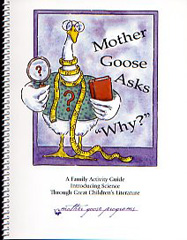
Children are naturally curious. They love to explore the world around them—they question, observe, predict, experiment, sort and classify, just like a scientist. Mother Goose Asks “Why?” links children’s literature to science by using picture books and a family activity guide filled with projects that make science learning fun. Like stories, scientific investigations usually start with a question or a problem. Reading provides opportunities to identify and explore problems using the imagination, process skills of science, and tools to find solutions. And reading together encourages the sharing of ideas. What does the program include? The Mother Goose Asks "Why?" family activity guide, picture books
and activity kit provide:
Download a free sample activity from the family activity guide or browse through the guide's table of contents.
Why Mother Goose asks “Why?” and who benefits from this program? The Mother Goose Asks “Why?” family activity guide, books and materials provide you with opportunities to actively explore and investigate and can help children ages three to six increase their skills of observing and noticing changes, making predictions, sorting and looking for patterns. Increasing these skills helps promote healthy cognitive and emotional development in children. Children succeed more when exposed to sophisticated vocabulary, have conversations with adults in the home and are exposed to cognitively challenging experiences. They are also capable of learning science skills at a very young age. Parents and other caregivers will gain skills and strategies for reading and talking with children ages three to seven. And everyone benefits when children are better prepared for school. This program kit introduces children to the process skills of science and has them exploring and investigating various aspects of design technology, earth and space science, life science and physical science. The skills that children develop from using this program will help them in school and throughout life.
Do Mother Goose Programs really make a difference? Mother Goose Programs fosters the interest and involvement of children in listening to and discussing a variety of picture, fiction and non-fiction books. There are multiple activities to help children develop a growing interest in reading-related activities based on stories, and promoting the engagement of pretend-reading with other children. Researchers have found that the program supported conversation in the home, encouraged book reading and program and science activities. Children will also have a better understanding of the science process skills and will have performed science activities that will help them have a better understanding of the world around them. Evaluation documenting the positive impact of Mother Goose Programs has been conducted by RMC Research Corp. (Denver, CO) and Learning Innovations at WestEd (Stoneham, MA).
Are the programs research-based? Researchers have found that complex conversations, thought-provoking questions, activities, and reflection all lead to strong language and literacy skills. Research has also shown that children are more successful when they are exposed to cognitively challenging experiences. Children also benefit from having conversations with adults in the home and from having picture books read to them regularly. Mother Goose Programs meet these needs and are based on the latest research concerning the cognitive development of children and best practice.
Is any special training required?
|
You Can Count On Mother Goose >
|
||||||||||||||||||||||||||||||||
privacy policy terms of use about us contact us site map
|
||||||||||||||||||||||||||||||||||